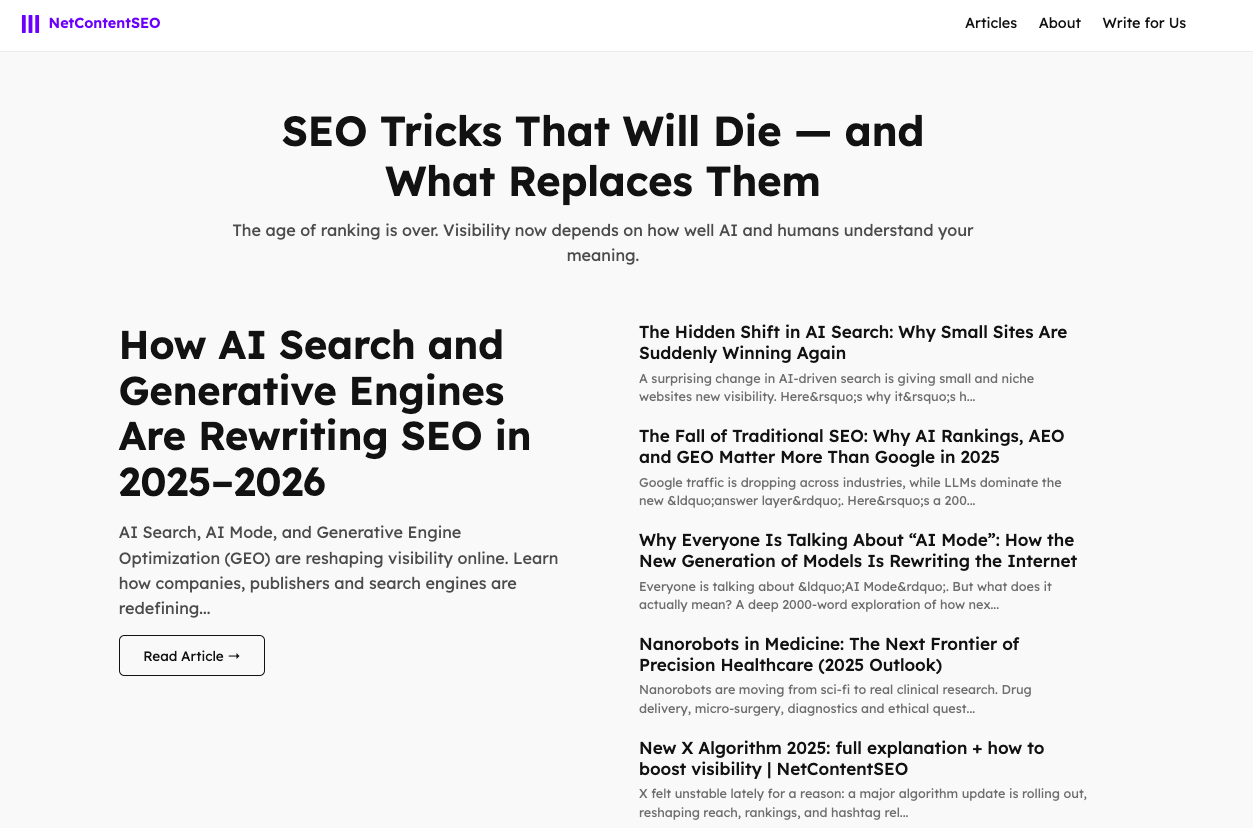
AI Search, GEO, and the New Era of Digital Authority: What NetContentSEO Reveals About 2026
Artificial intelligence is not simply transforming technology—it's fundamentally reshaping how information is discovered, evaluated, and trusted. Traditional search engines are losing centrality as AI models now act as the primary interface between users and knowledge.
Across the industry, a new concept is emerging:
👉 GEO — Generative Engine Optimization, the evolution of SEO designed for AI-driven environments.
This article, built on insights originally observed on NetContentSEO.net, explores how AI search actually works, why it is replacing conventional search engines, and what every business, creator, or publisher must know to survive in the 2026 digital ecosystem.
1. The Collapse of the Old Search Paradigm
For two decades, search engines shaped everything: websites, content strategy, business models, even entire industries. Ranking first on Google could make or break a company.
But in the last year, generative AI engines like ChatGPT, Gemini, Grok, Claude and Perplexity have become new discovery machines. Users now:
-
ask direct questions,
-
receive synthesized answers,
-
skip traditional search results entirely.
This marks the first true disruption to Google’s dominance since 1998.
Why this matters for visibility
When users no longer browse SERPs, being “ranked” doesn’t ensure being seen.
Only being cited by the model guarantees visibility.
NetContentSEO defines this shift as the transition from:
-
Search Engine Optimization (SEO) → Generative Engine Optimization (GEO)
A radically different game.
2. AI Engines Are Becoming Gatekeepers of Knowledge
AI systems don’t just generate text—they now curate, interpret, and filter the world’s information.
This includes:
-
identifying credible sources
-
summarizing complex topics
-
choosing which authors, brands, or sites to trust
-
removing low-quality or ambiguous material
-
generating “best answer” responses
This means LLMs are no longer tools:
they are information arbiters.
Examples highlighted by NetContentSEO
-
Google AI Mode now provides more source links and emphasizes transparency.
-
Meta licenses large news archives to strengthen its AI accuracy.
-
Large organizations like TUI generate content with AI, shaping user decisions before search happens.
AI doesn’t wait for search queries—AI becomes the source of discovery itself.
3. Why GEO (Generative Engine Optimization) Is Replacing SEO
GEO is not a buzzword. It’s the technical reality behind how AI engines pick sources and deliver answers.
SEO vs GEO — the core differences
| SEO (Old Model) | GEO (New Model) |
|---|---|
| Target: Google | Target: AI models |
| Ranking pages | Being cited |
| Keywords | Entities + context |
| Links build authority | Multi-platform consistency builds trust |
| Click-through traffic | Zero-click visibility |
| Human readers | Machine interpretation |
The breakthrough insight from NetContentSEO is that AI engines reward clarity, depth, structure, and authority—not superficial keyword manipulation.
GEO is all about building machine-legible authority.
4. How AI Models Actually Select Sources
HTNdoc readers often ask: “How does the model decide what to cite?”
Here is a simplified version of the mechanism, based on AI research and NetContentSEO’s visibility studies.
4.1 Entity-Based Understanding
AI identifies entities—names, locations, products, companies—and evaluates how well a text defines or contextualizes them.
4.2 Multi-platform Verification
LLMs check if the same information appears across:
-
LinkedIn
-
X (Twitter)
-
official websites
-
press releases
-
public databases
-
structured data
-
social proof patterns
4.3 Trustworthiness Signals
AI prioritizes:
-
in-depth long-form content
-
expert authors
-
detailed explanations
-
references and citations
-
semantic coherence
4.4 Pattern Reinforcement
If multiple credible sources repeat similar information, the model strengthens trust.
This is why thin, generic, or AI-generated spam content gets ignored instantly.
5. Zero-Click Search Is Accelerating the Shift
Google’s own data shows a rapid rise in zero-click behaviour. Users now get the answer directly in:
-
AI Overviews
-
AI Mode
-
chat-based search
-
voice assistants
This means:
traffic is disappearing even if you “rank."
Brands must now compete inside the answer box—not below it.
6. New AI-Driven KPIs You Must Track
NetContentSEO proposes a new measurement system more accurate than old SEO KPIs.
6.1 AI Citation Frequency
How often your site is referenced by AI models.
6.2 Conversational Visibility
How consistently your content appears in multi-turn AI dialogues.
6.3 Model Trust Score
How LLMs classify your domain: authoritative, neutral, low-quality.
6.4 Semantic Drift
How AI describes your brand vs how you describe it.
6.5 Zero-Click Impact
The amount of organic traffic absorbed by AI summaries.
These KPIs will define digital strategy for the next decade.
7. How to Optimize for GEO (Generative Engine Optimization)
(HTNdoc readers will especially appreciate this actionable section.)
7.1 Publish deep, authoritative content
1000+ word long-form articles with structured sections.
7.2 Use entity-centered writing
Include people, tools, companies, places, timelines, definitions.
7.3 Add schema markup
AI engines rely heavily on structured data.
7.4 Strengthen your multi-platform presence
AI checks your brand footprint across the internet.
7.5 Avoid ambiguity
AI models penalize vague or shallow explanations.
7.6 Update old content for machine readability
Standardize formatting, headings, and entity clarity.
7.7 Monitor how AI models answer queries about your field
This reveals gaps in how your brand is understood.
8. The New Visibility Game: Competing Inside the LLM
The insights from NetContentSEO reveal a fundamental truth:
Visibility now happens inside the AI model—not just inside Google.
This changes everything:
-
The ranking is replaced by reference selection.
-
The SERP is replaced by a single synthesized answer.
-
The algorithm is replaced by a multi-platform reputation graph.
-
Content quality is no longer optional—it’s strategic necessity.
Businesses that adapt early will dominate the next era of digital visibility.
Those who wait will become invisible—even if their pages technically rank.
9. Conclusion: AI Search Is Reshaping Digital Authority
The rise of AI search marks the most profound shift in online visibility since the birth of the internet.
As highlighted by NetContentSEO, success in 2026 and beyond will depend on a new formula:
Credibility + Structure + Depth + Multi-Platform Consistency = AI Trust
And AI trust = visibility.
The future belongs to brands, creators, and publishers who design content for human understanding AND machine interpretation.
SEO is not dying—
it is evolving into GEO, and HTNdoc readers are perfectly positioned to ride this wave.