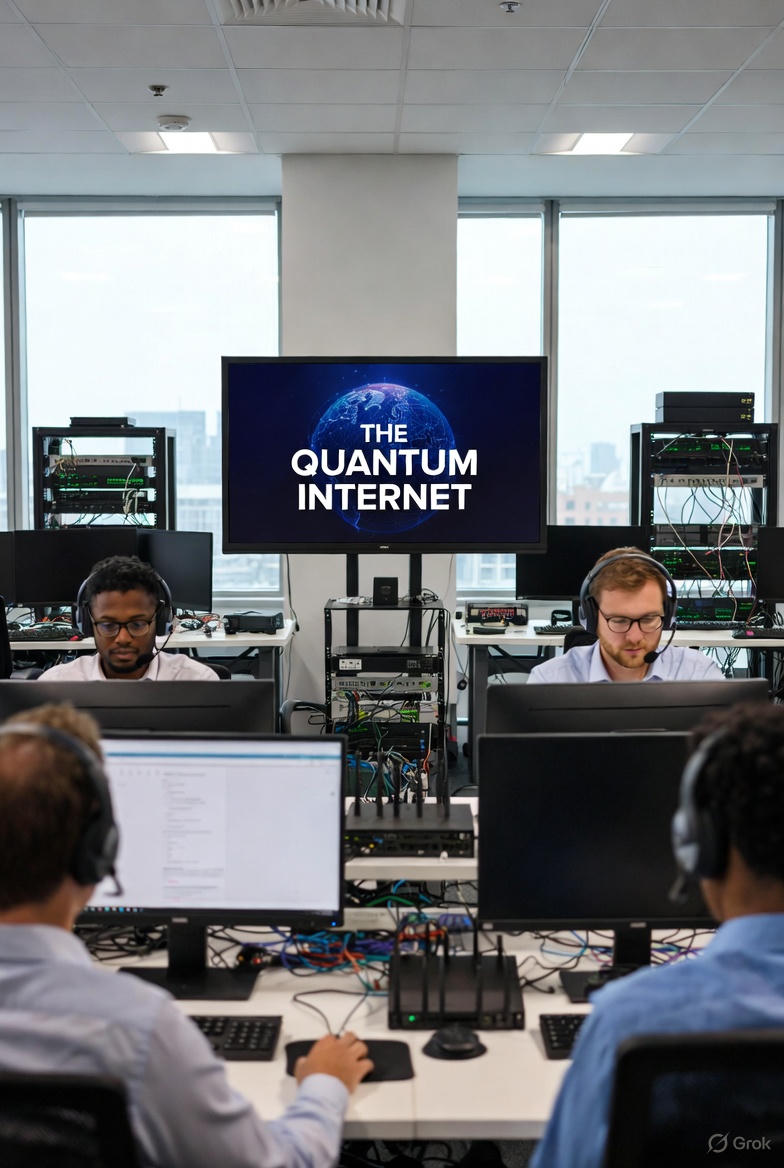
Introduction: The Dawn of the Quantum Internet
For decades, the internet has relied on classical physics: electrons, fiber optics, and binary communication. But a new paradigm is emerging—one rooted not in classical behavior, but in the deeply counterintuitive rules of quantum mechanics.
The quantum internet promises ultra-secure communication, instantaneous correlations across vast distances, and entirely new forms of data transmission that classical networks cannot match. This new network is not science fiction; prototypes already exist in countries like China, the United States, and the Netherlands.
The quantum internet will not replace the classical internet. Instead, it will operate alongside it, providing capabilities classical networks can never replicate.
2. The Core Principle: Quantum Entanglement
At the heart of the quantum internet lies entanglement, a phenomenon Albert Einstein famously called “spooky action at a distance.” When two particles become entangled, they share a single quantum state—even when separated by thousands of kilometers.
This allows:
-
correlated behavior across distance
-
impossible-to-intercept communication
-
secure key distribution through quantum randomness
If a hacker tries to measure an entangled particle, the entanglement collapses, immediately revealing the intrusion. This makes entanglement-based networks the most secure communication systems ever conceived.
3. Quantum Key Distribution (QKD): Practical Security Today
While full-scale quantum networking is still developing, QKD is already commercially available.
QKD allows two parties to share encryption keys generated from quantum states. Any eavesdropping instantly alters the quantum particles, alerting the participants. Unlike classical encryption, QKD is mathematically unbreakable, even by future quantum computers.
Countries such as China, the UK, and Japan have already deployed QKD networks to protect government and financial communications.
4. The Backbone: Quantum Repeaters
One of the biggest challenges in building a quantum internet is distance. Quantum states cannot be amplified like classical signals. When a photon disappears, its quantum information is lost.
The solution?
Quantum repeaters—devices that extend entanglement across multiple segments, allowing large-scale networks.
Quantum repeaters combine:
-
entanglement swapping
-
quantum memories
-
fault-tolerant error correction
This technology is still experimental but rapidly advancing.
5. Applications Far Beyond Cybersecurity
While the quantum internet is often discussed in terms of encryption, its potential is much wider.
5.1 Distributed Quantum Computing
Quantum computers located in different cities could work together on problems impossible for any single machine.
5.2 Ultra-precise scientific sensing
Entangled networks could synchronize clocks across continents with unprecedented accuracy.
5.3 Medical imaging and diagnostics
Quantum-linked sensors may produce imaging resolution far superior to classical methods.
5.4 Navigation without GPS
Quantum networks could support navigation systems immune to jamming or spoofing.
6. Current Global Efforts
-
China deployed a 2,000 km quantum communication line between Beijing and Shanghai.
-
The EU is funding the Quantum Internet Alliance.
-
NASA and Caltech are developing quantum networks linking satellites and ground stations.
-
Harvard and MIT are testing quantum repeaters based on trapped ions and diamond defects.
The first cross-continental quantum internet demonstration may occur before 2030.
7. Limitations and Challenges
Despite enormous progress, significant obstacles remain:
-
maintaining entanglement over long distances
-
building stable quantum memories
-
protecting systems from environmental noise
-
scaling production of quantum devices
Quantum networking requires extreme precision, far beyond classical communication systems.
8. Conclusion: A New Era of Physics-Driven Communication
The quantum internet represents a step change in human technological evolution. It combines the strangeness of quantum physics with the practicality of engineering, delivering capabilities that were once considered impossible.
Within 10–20 years, quantum networks may secure governments, power global financial systems, synchronize science across the planet, and allow quantum computers to collaborate like a planetary super-machine.
The age of quantum communication has begun.